Enterprises that use OpenAI’s agent platform are far more likely to build on it than those that use Anthropic’s, according to new data from the August VB Pulse survey. Of the 75 companies that have OpenAI’s Agents SDK or Responses API somewhere in their stack, 52, or 69%, name it their primary orchestration platform. That number drops to 38% for Anthropic’s Claude Platform and Agent Skills, where only 17 of the 45 users count it as their main choice. These figures include enterprises that use both vendors, counting them in each group.
OpenAI Leads in Primary Platform Adoption
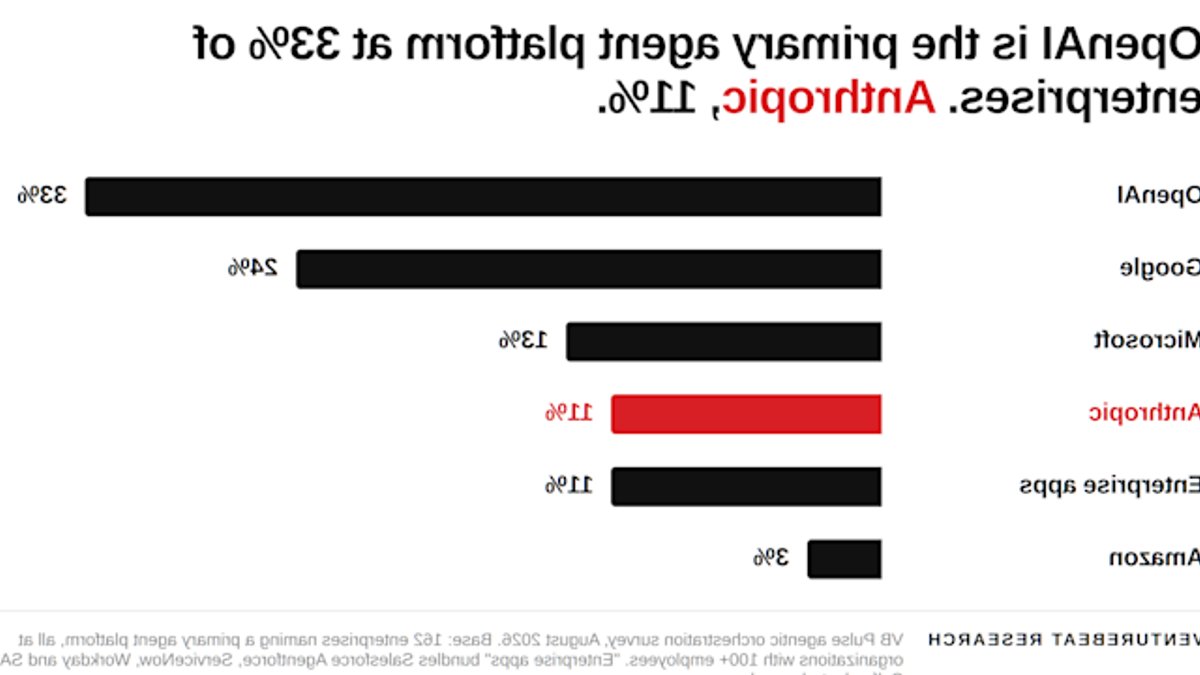
On the measure of primary platforms alone, OpenAI leads the August wave. Of the 162 organizations that named a single primary platform, 53, or 33%, chose OpenAI. Google’s Enterprise Agent Platform follows with 39, or 24%, and Anthropic trails with 18, or 11%. This 38% primary rate is the lowest for any platform in at least 25 enterprise stacks, and the pattern holds across company sizes and industries, though the specific groups are too small to report as percentages.
Current industry debates about enterprise adoption often focus on spending data from Ramp and OpenRouter, but these metrics fail to distinguish whether companies are just experimenting with a platform or fully integrating it. OpenRouter’s weekly data reveals that OpenAI’s models surpassed Anthropic’s in spending for the first time since February 2024, during the week of September 7. Similarly, Ramp’s breakdown of enterprise AI expenditures shows OpenAI’s Astra model overtaking Anthropic’s Fable in September.
Spending Data Fails to Capture True Market forces
For the buyers in this survey, however, the direction of that spending does not tell the whole story. OpenAI is in 75 of 168 enterprise stacks and is the primary platform at 52 of them. Anthropic is in 45 and is primary at 17, the lowest primary-platform rate of any platform in at least 25 stacks, while drawing more forward consideration relative to its installed base than any competitor.
Among the 121 enterprises that named platforms they are considering adopting, adding or replacing in the next 12 months, 36 named Anthropic against the 45 that use it today. That ratio of consideration to current use is the highest of any platform used at 40 or more enterprises in the survey. OpenAI drew 41 considerers against 75 users, Google 30 against 65 and Microsoft 15 against 31.
Read Also: Cohere encrypts AI inference for enterprises
When a company runs AI agents that take several steps—reading a file, calling a tool, deciding something and calling another tool—a coordinating layer has to decide what runs when, what each agent may touch and what happens when a step fails. That layer is the agent control plane, and where it lives is the structural decision enterprises are making right now. A quarter of enterprises expect a model provider to own it.
Asked where they expect the primary control plane for enterprise agents to live by the end of 2026, 44 of 169 respondents, or 26%, said a provider-managed agent service, second only to a hybrid of provider-native and external orchestration, chosen by 55, or 33%. Inflexibility across models and tools is the main concern enterprises have about letting a model provider hold orchestration control, chosen by 48 of the 169 respondents, or 28%. Vendor lock-in ranks fourth at 16%, or 27 of 169.
Both Ramp and OpenRouter track real-world usage, but neither aligns with the companies surveyed here. OpenRouter’s user base consists mostly of developers and end users, with over half of activity coming from outside the U.S. Large corporations typically secure model access through direct contracts or platforms like Amazon Bedrock, Google Vertex AI, or Microsoft Azure rather than routing services. Meanwhile, Ramp’s September data presents conflicting signals: its model-level spending chart shows OpenAI’s Astra surpassing Anthropic’s Fable, but its broader AI Index from September 9 places Anthropic at 43.8% of U.S. businesses in August versus OpenAI’s 39.8%, with Anthropic’s growth outpacing OpenAI’s. Ramp’s data relies on corporate card transactions from its own platform, excluding enterprises using alternative spend-management tools.
Anthropic Holds Edge in Future Interest
Despite OpenAI’s lead in primary platform adoption, Anthropic holds a distinct advantage in future interest. Sixty percent of the 169 respondents, or 101 enterprises, plan to adopt, add or replace an agent orchestration platform within the next 12 months. Of those, 47, or 28%, plan to make a move within the current quarter. This high rate of change suggests the market is still in an early stage of experimentation and consolidation. For Anthropic specifically, the open question is whether this forward-looking interest will translate into primary platform positions, or if enterprises will continue to install it alongside a platform they build on instead.
The methodology of the VB Pulse tracker limits the ability to draw trend lines. Each monthly wave draws a different mix of respondents, and results have moved with that mix. Consequently, every figure in this article is an August cross-section rather than a trend. The sample is self-selected from VentureBeat’s audience and research panel, not a probability sample. This means the figures describe these respondents and generalize to the wider market only as far as that mix allows. The current wave also skews toward mid-market companies outside of technology. Seventeen of the 169 respondents, or 10%, are in technology and software, compared to 53% in the previous July wave.


