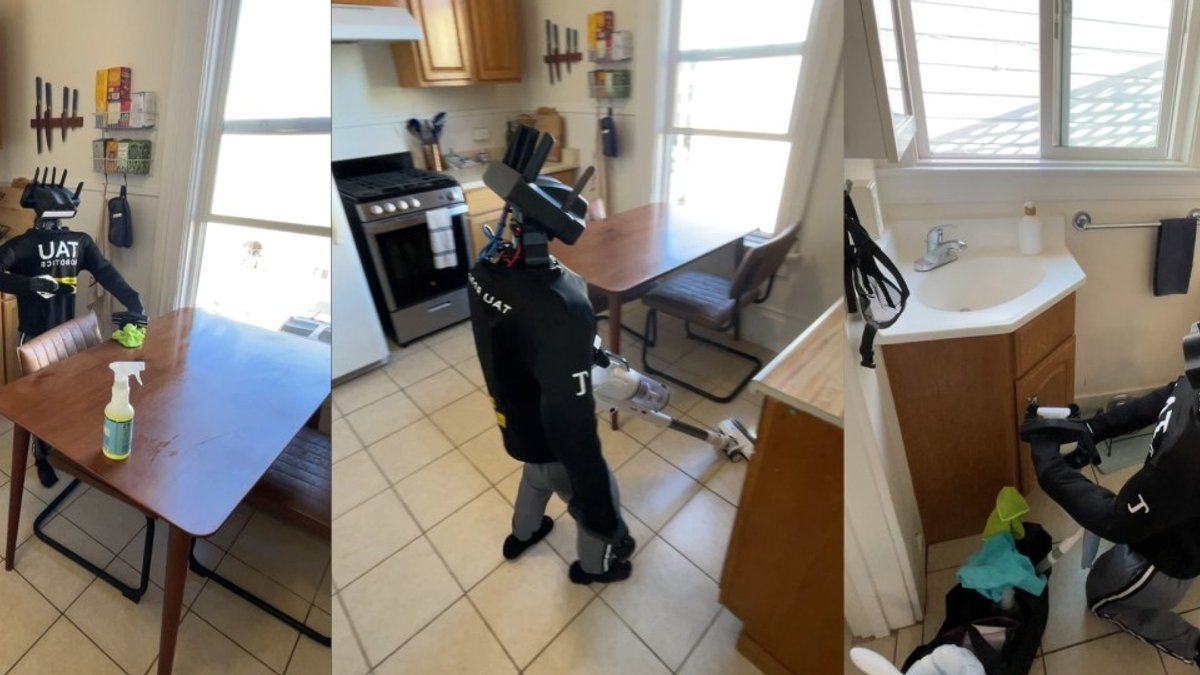
When a San Francisco renter signed up for a one-hour session with a humanoid robot cleaning service, the price tag read $30—a rate that seemed modest for a prototype that could one day replace housekeepers.
How the service works
Tau Robotics, the startup behind the offering, equips each four-and-a-half-foot unit with cameras in its head and wrists. Human pilots at the company’s headquarters watch those feeds and steer the robot in real time, while the machine records every motion for later training.
Because the data are essential to improving the system, the company keeps the fee low. The current schedule lists $60 for weekly service with two robots or $100 for a single, one-time visit. Even at the reduced price, the robot moves slowly, so a homeowner who prefers to watch the demo could finish the chores faster on their own.
The robot’s exterior combines a 3D-printed “head” with antennae and a pair of claw-like hands. The claws replace more human-like fingers, which proved too fragile for repeated scrubbing. Grippy socks protect hardwood floors, and a branded Tau shirt identifies the unit.
Read Also: Democrats win Texas AI hub faces grid scrutiny
Tasks that require precise manipulation, making a bed or folding laundry, use what Tau calls “kinematic guidance.” The remote operator performs the motion, sensors capture the trajectory, and the robot mirrors it. This method yields high-value examples for the AI models that still cannot fold a shirt independently.
Co-founder Cornelia Weinzierl told reporters that the robot can already vacuum and mop without human input. According to Weinzierl, fully independent cleaners could become a tourist draw as Waymo cars have.
First field test
The initial visit began with the robot arriving in a blue minivan, escorted by Weinzierl and a staff member. The unit faced an eight-step stairwell to reach the apartment building. Observers described its ascent as unsteady, with occasional backward steps that erased progress but never caused a full fall.
Weinzierl explained that the robot’s gait can appear “drunk” because the remote operator experiences a slight signal lag, which throws off timing. “The amount of work and time that we spend just optimizing, for example, timings and connectivity is crazy,” she said.
Read Also: Texas AI Buildout Faces Political Roadblocks
Inside, a carpeted staircase halted the robot entirely, forcing the staff to carry it the final steps. The heatwave that week also caused the controller’s monitoring equipment to overheat, prompting an early departure before the hour elapsed.
Tau sent a prompt apology email after the first visit, acknowledging the technical hiccup and offering a complimentary repeat cleaning.
Future Outlook and Societal Impact
A senior leader explained that the cleaning industry suffers from high turnover and frequent injuries, making robot assistance an attractive solution. The shortage of willing workers, according to the executive, drives the push toward autonomous devices.
Beyond household chores, the firm is evaluating deployments in environments such as mold remediation and home-health assistance, where physical strain and safety concerns are pronounced. These prospective roles would still rely on remote operators during the development phase.


